
Sinch
Sinch is a cloud communications platform providing APIs for SMS, voice, video, fax, verification, and omnichannel messaging. The platform sends 250 billion messages per year with direct carrier connections.
What is Sinch?
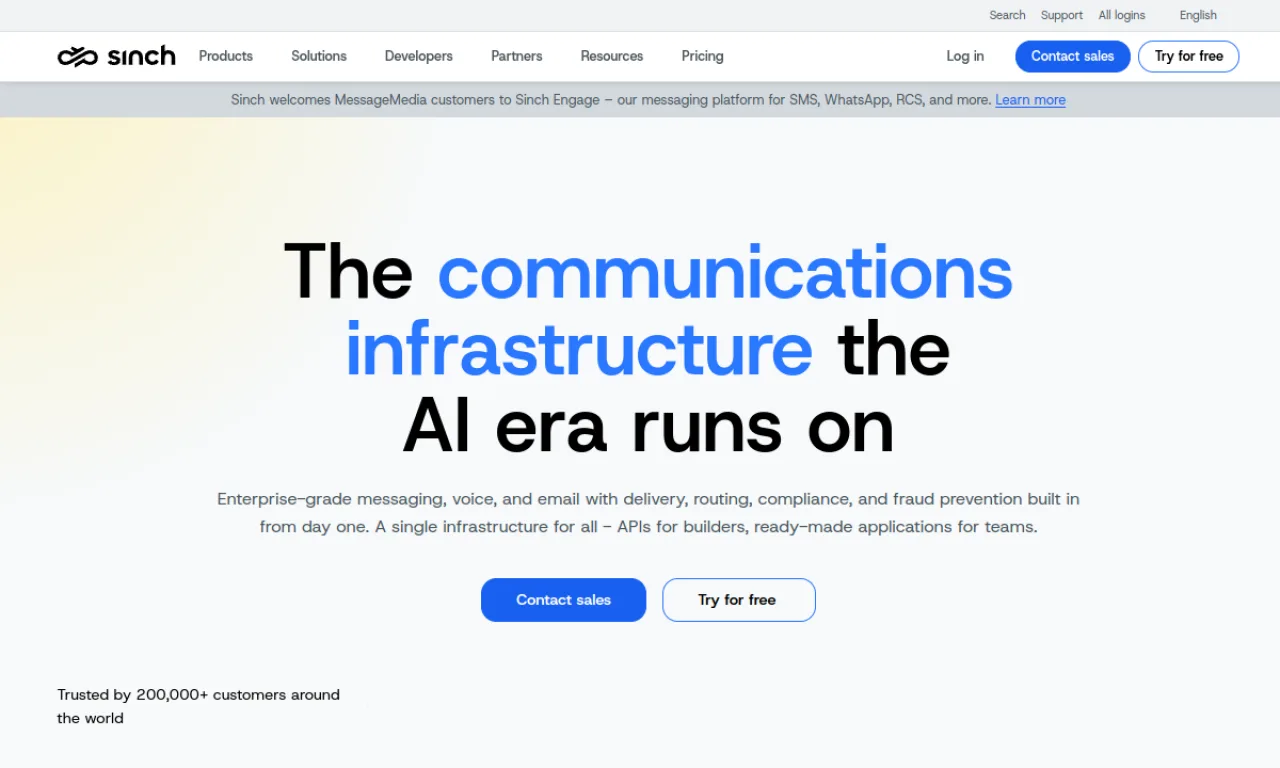
Sinch is a cloud communications platform (CPaaS) that gives developers and revenue teams API access to SMS, voice, video, email, verification and omnichannel messaging. It runs roughly 250 billion messages a year over direct connections to 600+ carriers in 190+ countries.
For GTM teams, Sinch matters in three places: transactional and marketing SMS at scale, phone-number verification and OTP flows, and omnichannel customer messaging across WhatsApp, RCS and the rest.
The two products most buyers are actually choosing between:
- Sinch SMS API / Conversation API: developer-first, pay-as-you-go, no platform fee. What you buy if you have engineers.
- Sinch Engage: a no-code messaging and campaign product with monthly subscription pricing. What you buy if you don't.
Confusing the two is the single most common reason people misjudge Sinch's cost.
Sinch pricing in 2026
Sinch SMS API — pay-as-you-go, no monthly platform fee:
| Route | Rate (US) |
|---|---|
| 10DLC outbound | $0.0078 per message |
| 10DLC inbound | $0.0078 per message |
| Short code | $0.009 per message |
Carrier pass-through fees apply on top of all base rates — this is standard across every CPaaS and is the number that usually blows up naive cost models. Budget an extra $0.003–$0.005 per message in the US.
Sinch Engage is priced separately on monthly subscription tiers starting around $49/month, scaling with contacts and conversation volume. Real invoices at higher usage have been reported in the $800+/month range, so treat the entry price as a floor, not a forecast.
Enterprise volume pricing is negotiated and not published.
Rates compiled from Sinch's published pricing and third-party pricing analyses; verify current rates for your destination countries before modelling.
Key features
- SMS API - direct connections to 600+ carriers across 190+ countries
- Conversation API - one integration covering 14 messaging channels (WhatsApp, RCS, Messenger, Viber, and more)
- Voice API - programmable voice, SIP trunking, global PSTN termination
- Verification API - OTP and phone-number verification flows
- Brands API / Registration API - 10DLC sender ID and campaign registration, which is now mandatory for US A2P messaging
- Provisioning API - programmatic service configuration
- Enterprise security - encryption, consent management, regional data residency, audit trails
- Sinch Engage - no-code campaign and inbox layer for non-technical teams
The Conversation API is the genuine differentiator. Building WhatsApp, RCS and SMS separately is weeks of engineering per channel; one integration covering 14 is a real reduction in scope.
Pros and cons
Pros
- No monthly platform fee on the SMS API, you pay for messages, full stop
- Direct carrier relationships rather than reselling, which shows up as better deliverability on international routes
- Conversation API meaningfully reduces omnichannel integration work
- Genuine global depth, 190+ countries is more than most competitors can service well
- Handles 10DLC registration compliance, which is a non-trivial headache in the US
Cons
- Developer experience and documentation rate below Twilio and Infobip in user reviews — integration takes longer
- The product portfolio is sprawling and confusingly named after years of acquisitions; working out which SKU you need is genuinely hard
- Enterprise pricing is opaque and requires sales contact
- Per-message rates are mid-market, not cheapest, Telnyx and Bird undercut it materially
Who Sinch is best for
Good fit: companies sending high international message volume, especially into markets where carrier relationships matter more than API polish. Also strong for teams that need genuine omnichannel (WhatsApp + RCS + SMS) rather than SMS alone.
Poor fit: US-only startups optimising purely on per-message cost, Telnyx at $0.0025 and Bird at $0.0033 are meaningfully cheaper. And small teams without engineering resource should be looking at Sinch Engage or a marketing-first SMS tool, not the raw API.
Sinch vs Twilio vs the alternatives
| Provider | US outbound SMS | Platform fee | Best for |
|---|---|---|---|
| Sinch | $0.0078 | None | Global reach, omnichannel, carrier depth |
| Twilio | $0.0083 | $1.15/mo per local number | Best developer experience, biggest ecosystem |
| Bird (MessageBird) | $0.0033 | None | Lowest cost among the majors |
| Telnyx | $0.0025 | None | Cheapest rates, owns its network, transparent pricing |
| Infobip | Custom | Custom | Enterprise omnichannel, rated easier to deploy than Sinch |
| Plivo | Custom (low) | None | Cost-conscious mid-market, solid docs |
| Vonage | Custom | Varies | Voice-led use cases |
All rates exclude carrier pass-through fees. Verify current pricing before committing.
Sinch vs Twilio: the real trade-off is developer experience versus international depth. Twilio has the better docs, the bigger ecosystem and the shorter time-to-first-message; Sinch has stronger direct carrier relationships and marginally cheaper base rates with no per-number platform fee. For a US-only product, Twilio usually wins on speed of implementation. For genuinely global sending, Sinch's carrier position tends to show up in deliverability.
Sinch vs Bird: Bird is roughly 58% cheaper per US message. If you're sending high domestic volume and your routes are simple, that gap is hard to argue with. Sinch's case is international coverage and channel breadth.
Sinch vs Infobip: closest peer, similar enterprise positioning, similar global footprint. Reviewers consistently rate Infobip easier to integrate and deploy. Worth trialling both.
Verdict: is Sinch worth it?
Sinch is the right choice when your problem is reach, many countries, many channels, deliverability that has to hold up on routes where resellers struggle. The Conversation API is a genuine engineering saving if you need more than SMS.
It's the wrong choice if your problem is price or speed of integration. Telnyx and Bird are cheaper; Twilio is faster to build on. Sinch sits in the middle on both and wins on breadth.
Ideal Customer Profile
Pricing
From $0.0078/message
Frequently Asked Questions
Cloud communications platform for SMS, voice, video, and omnichannel messaging
G2 Rating
3.8/5Starting Price
From $0.0078/messageAPI
AvailableFunding
$1.2 BillionCustomers
200,000

 Salesforce
 Zoom
Zoom Klaviyo
 Lovable
 Mailjet
 Zoho
Zoho Shopify
 BigCommerce

